
Moving humanitarian cash transfers from pilot to programme
The pilots worked. Running them as programmes, year after year and grant after grant, is a different job.
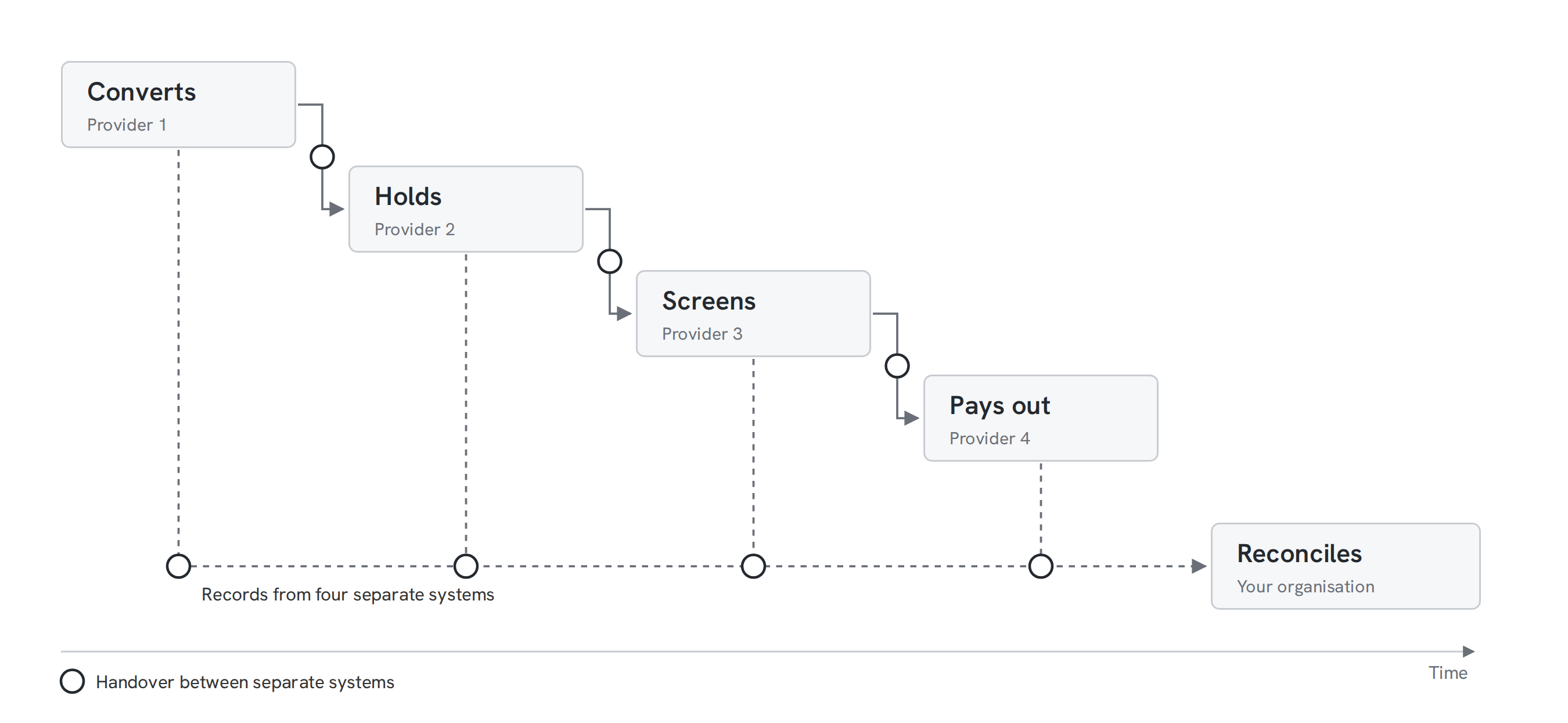
Follow a donor grant from a bank account to a family and count the providers. One converts the money into stablecoin. Another holds it. A third screens the recipient list, a fourth pays out, a fifth audits the results, and the organisation reconciles all of it for the donor. Each provider needs its own vetting and contract before the first payment goes out.
Each provider can do its job well, and payments still go wrong at the joins between them. WFP, describing what happens when many agencies run separate systems, lists the consequences: some households paid twice, others left out, slow reconciliation, avoidable cost.
When something does go wrong, each provider can truthfully point upstream or downstream. The organisation holding the donor relationship has to work out what happened across systems it does not own. That cost never shows up in a pilot report.
A pilot has a sponsor who will hold five provider relationships together for six months. A programme needs something that holds without them.
Running cash transfers at scale comes down to governance: who can release funds, under which rules, and how an organisation shows a donor what happened to each dollar or euro. NBX built the parts that answer those questions as one setup. Conversion and issuance happen inside one regulated entity, approvals and audit sit in one record, and payments go straight from the organisation’s treasury to recipients. That leaves fewer providers to vet and fewer joins for a payment to fall through.
The setup also changes who handles money. In many cash programmes, the people who register households also carry the cash. A field officer verifies a family in the morning and hands over an envelope in the afternoon, and the risk stays with the staff closest to the people being helped. Here, field teams register households with the tools they already use, and the organisation pays each one directly from its treasury. The field collects information. It never touches money.
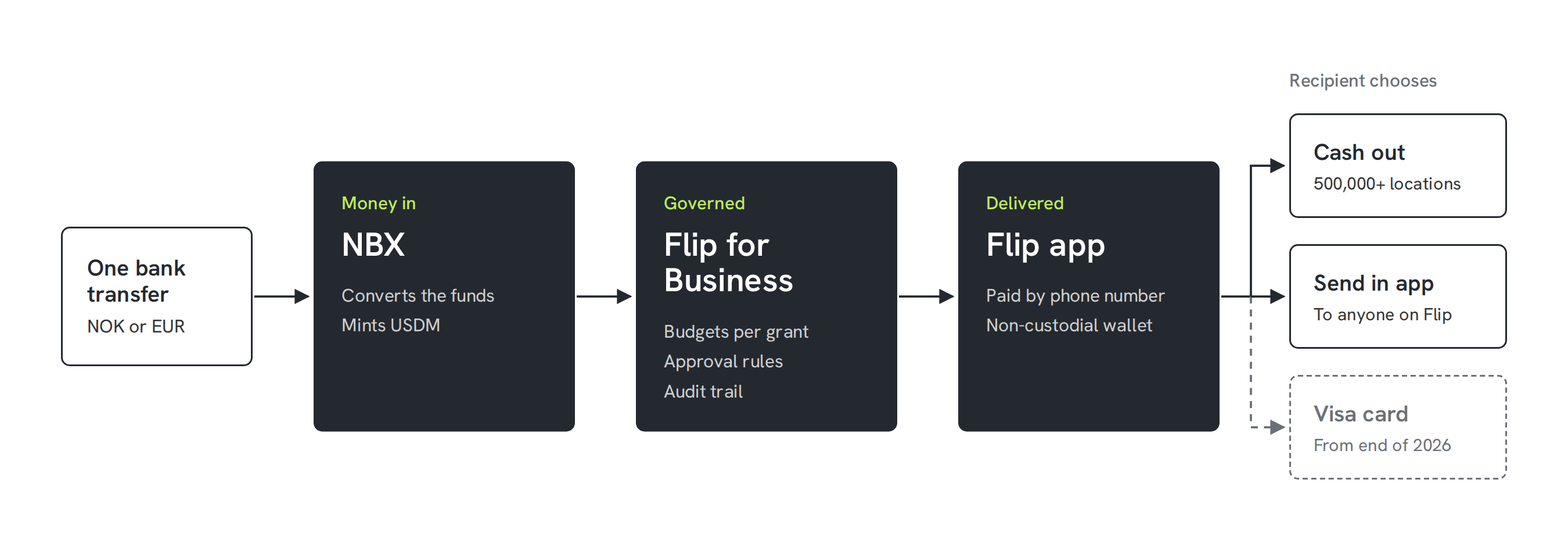
An organisation funds its NBX account with one bank transfer in NOK or EUR. NBX converts the funds and mints its own fiat-backed stablecoin within one regulated entity, so the money does not pass through a separate exchange or issuer. NBX is MiCA-authorised and supervised by Finanstilsynet, and its stablecoins are issued under an e-money licence held through Finanstilsynet. Redemption follows the same route in reverse, back to the organisation’s bank account.
Many humanitarian budgets arrive in euros, and every conversion into US dollars costs part of the grant and adds a line the organisation has to explain to its donor. Euro programmes run on EURn, NBX’s euro stablecoin, which is slated for launch soon, so a euro grant stays in euros from the bank account to the recipient’s phone. Dollar programmes run on USDM, which is live today.
In Flip for Business, the organisation holds the funds in its own non-custodial wallet, and NBX configures the setup around the organisation’s own structure. Headquarters allocates budgets to offices and programmes, ties each budget to a donor grant and calls it back when plans change. Offices approve payments within the limits headquarters sets, and Flip for Business checks those limits before a payment is signed.
Approvers confirm payments on their own phones, and no single party, the technology provider included, can move funds alone. Every step, from the bank reference through allocation, screening and approval to delivery, links to the one before it, and donor reports per grant come straight from that record.
Flip for Business checks each registration list for duplicates, records consent and links each household to a wallet in the Flip app, where a phone number replaces the blockchain address. The wallet is non-custodial and needs no bank account, and recipients never have to buy a separate token to cover network fees.
Recipients can cash out through NBX’s global remittance partner at more than half a million locations, and from 2027 they will also be able to spend with the Visa card. They can send money to anyone else in the app, such as a relative in another town or a local shopkeeper. Where enough people nearby use the app, the money stays useful without being converted at all, and the recipient decides when it leaves.
A programme does not have to move every payment at once. Part of the budget can still go out as cash through local partners, paid as partner grants under the same approval rules and audit trail.
NBX built these layers together because owning the parts that decide what happens to a payment lets NBX say in advance what will happen and answer for it afterwards.
NBX does not own everything. The networks the money moves on, the card scheme, the cash-out locations and the key-management technology belong to others. NBX works with established key-management specialists and can fit the setup to an organisation’s own vendor and due-diligence requirements. For many recipients, cash will remain the right answer for a long time.
If you run cash transfers and recognise the joins described here, we would like to hear how they show up in your work. Book 30 minutes with Christian.
Yes. The organisation sends funds from its own non-custodial wallet straight to each recipient’s Flip app, addressed by phone number. NBX provides the infrastructure and does not distribute funds on anyone’s behalf. Recipients need a smartphone with the app rather than a bank account, and can hold the money, send it to others in the app or cash it out. Unlike the SMS-based UNICEF test, the Flip app does not run on basic phones. For households without a smartphone, the organisation can pay a local field partner directly as a partner grant.
With Flip for Business, each payment links back through approval, screening and allocation to the original bank transfer and donor grant. Organisations can export reports per grant, with approvals and on-chain receipts, rather than screenshots of a blockchain explorer.
Not to receive money or send it to others inside the Flip app, because the wallet is non-custodial. Identity checks apply when a recipient cashes out or, once it launches in 2027, uses the Visa card. NBX’s compliance team and the organisation plan in advance how this works for recipients with temporary or unfamiliar documents.
There is no standard price list. NBX agrees pricing with each organisation, based on how its programme is set up. Under MiCA, holders can redeem the stablecoin at par, and redemption of a fiat-backed stablecoin carries no redemption fee.
Coverage is assessed programme by programme. Before a programme starts, NBX and the organisation review each country together, including sanctions requirements and the cash-out options available locally.
NBX is supervised by Finanstilsynet and handles personal data under the requirements that apply to regulated financial institutions in the EEA, including GDPR.
This is a marketing communication. It does not constitute investment advice or a personal recommendation to buy, sell, hold, convert or transfer any crypto-asset. NBX does not provide investment advice on crypto-assets.
E-money tokens involve issuer, operational, regulatory and blockchain-related risks. An e-money token is not a bank deposit and is not covered by a deposit guarantee scheme. Redemption rights, fees, conditions and risks are described in the relevant white paper and terms.
Holders of USDM issued by NBX have the right to redeem at any time, at par value, from NBX, subject to the applicable terms and white paper.
A crypto-asset white paper for USDM has been published by Norwegian Block Exchange AS and is available at nbx.com/en/usdm. Issuer contact: nbx.com, +47 91 92 17 81, notifications@nbx.com.
Norwegian Block Exchange AS, org.nr 920 245 676.

