
Running stablecoin cash transfers across offices and donor grants
In many humanitarian cash programmes, the people who register households also carry the money. A field officer verifies a family in the morning and hands over an envelope in the afternoon, or a local partner receives a transfer and pays out from it.
This has worked for decades. It also leaves cash, and the risk that comes with it, with the staff and partners closest to the people being helped.
Pilots over the past few years suggest they do. In Mercy Corps' Project Lydian pilot, digital currency transfers cut transfer costs per household by 10.87%, from $93.36 to $82.31, enough to reach 131 more households on the same $100,000 budget. In a Mercy Corps anticipatory cash pilot in Kenya, transaction costs fell by 75% and payments settled 90% faster. UNICEF's Nairobi test delivered to 49 recipients on basic phones over SMS, and every participant received and converted their funds.
These pilots show that the payment itself works. They show less about running stablecoin cash transfers year after year across many offices and donor grants, with an audit at the end of each grant.
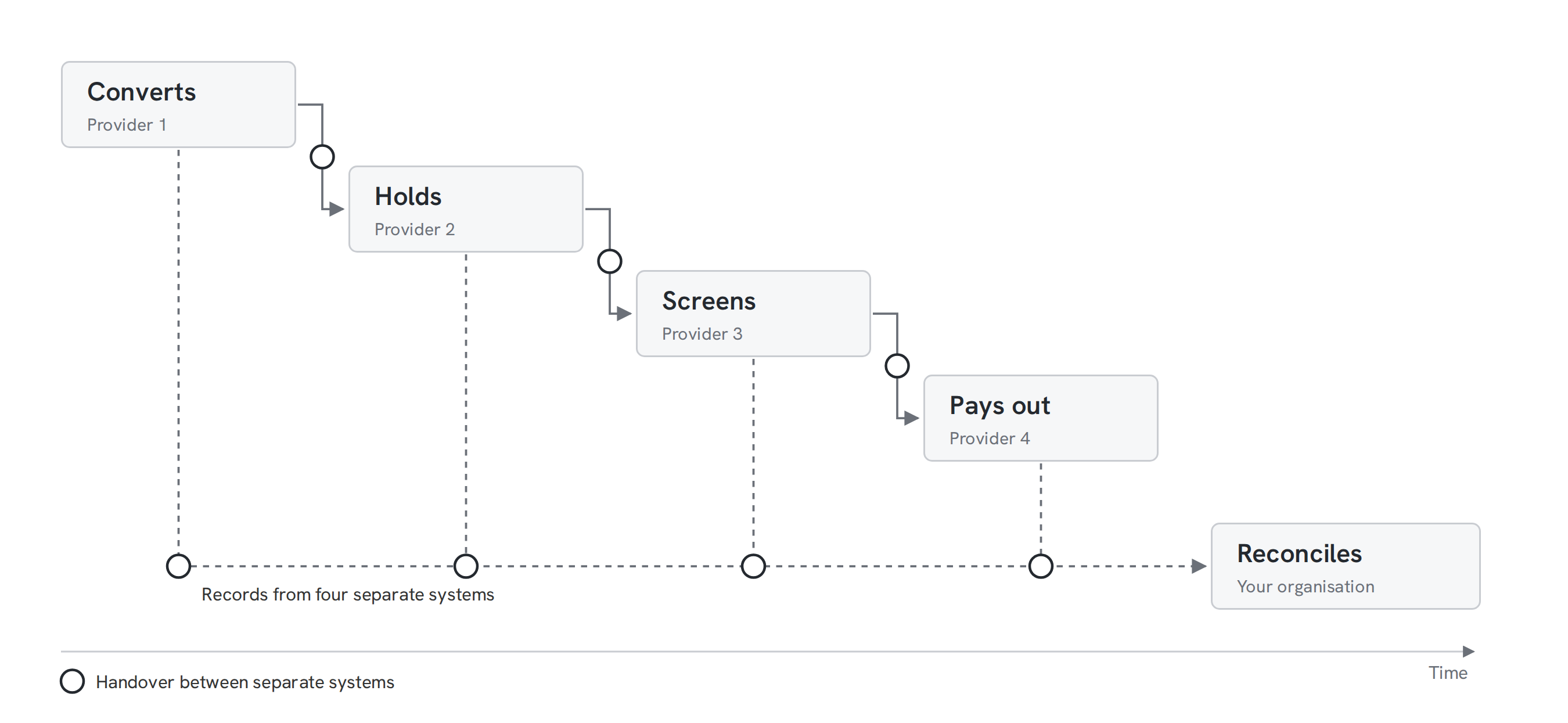
Scaling depends on governance: who can release funds, under which rules, and how an organisation shows a donor what happened to each dollar. Today that work is usually split across several providers. One converts the money, another holds it, a third screens recipients, a fourth pays out, and the organisation reconciles the results. WFP, describing what happens when many agencies run separate systems, lists the consequences: some households paid twice, others left out, slow reconciliation, avoidable cost.
Organisations can run stablecoin cash transfers on NBX infrastructure in three layers. Funds enter through NBX, a MiCA-authorised and EMI-licensed company supervised by Finanstilsynet in Norway, which converts them into USDM, its MiCA-compliant US dollar stablecoin, within one regulated entity. In Flip for Business, the organisation holds the funds in its own non-custodial wallet and applies its own approval rules. The organisation then pays recipients directly in the Flip app, by phone number.
NBX's conversion and USDM issuance, key custody through BlockSign, and the Flip app are live today. NBX configures the governance layer for each organisation around its own structure and rules.
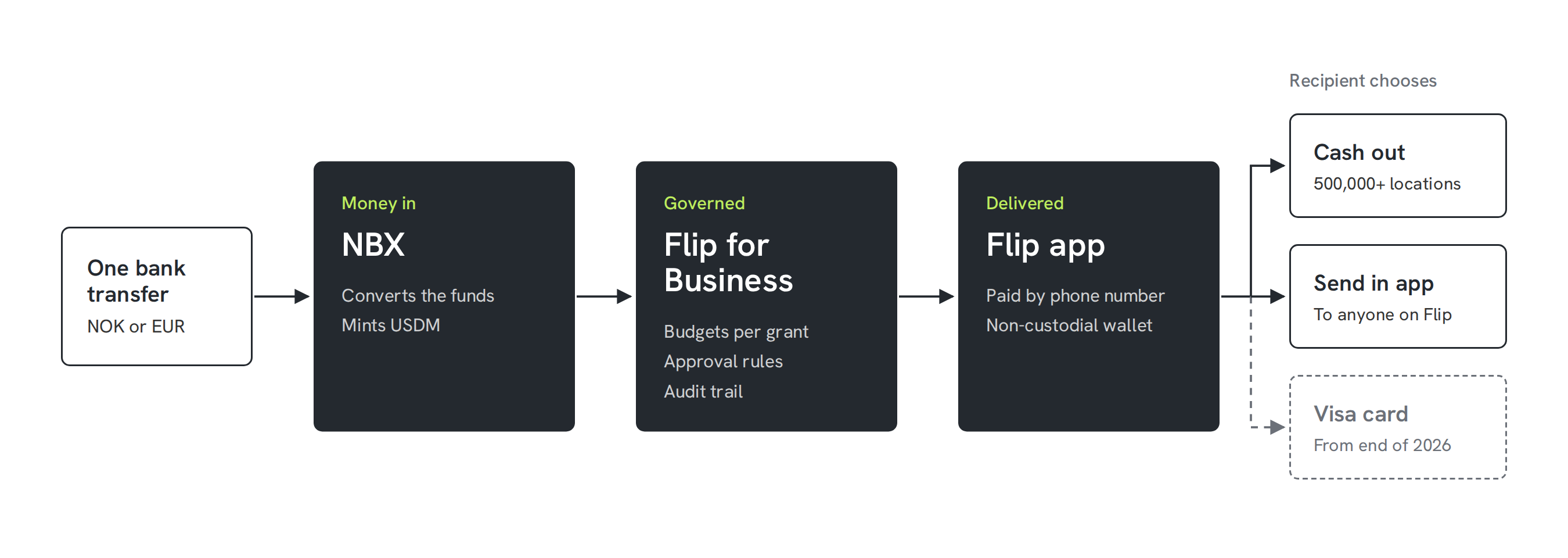
An organisation funds its NBX account with one bank transfer in NOK or EUR. NBX converts the funds and mints USDM itself, so the money does not pass through a separate exchange or issuer. Redemption follows the same route in reverse, back to the organisation's bank account. After that single transfer, the organisation can make as many payouts as it needs without returning to the bank. A euro stablecoin, EURn, is in development.
In a pilot, approvals and reconciliation are often handled by hand. Flip for Business replaces that with rules the organisation sets. Headquarters can allocate budgets to offices and programmes, tie each budget to a donor grant, and call it back when plans change. Each office can approve payments within limits headquarters sets, and Flip for Business checks those limits before any payment is signed, so a payment that breaks the rules does not go out.
The organisation keeps control of its own funds. Key custody runs on BlockSign, NBX's custody partner. BlockSign splits each signing key between independent parties so that nobody, BlockSign included, can assemble it, and approvers confirm payments on their own phones. Nobody has a recovery phrase to write down or lose.
Once Flip for Business is set up, it records every step, from the bank reference through allocation, screening and approval to delivery, and links each record to the one before it. Donor reports per grant come straight from that record.
Field teams register households with the tools they already use. Flip for Business can then check the list for duplicates, screen it against sanctions lists, record consent and link each household to a wallet. The field collects information. It never touches money.
The organisation pays from its treasury straight to each household's phone. Recipients use the Flip app, where a phone number replaces the blockchain address. The wallet is non-custodial and needs no bank account, and recipients never have to buy a separate token to cover network fees.
Recipients decide what to do next. They can cash out through NBX's global remittance partner, which has more than half a million locations, and from the end of 2026 they will also be able to spend with the Visa card where cards are accepted. They can send money to anyone else in the app, such as a relative in another town or a local shopkeeper. Where enough people nearby use the app, the money can stay useful without being converted at all.
Recipients can receive money and send it on inside the app without further onboarding, and identity checks apply only when they cash out or use the card.
A programme does not have to move every payment at once. Part of the budget can still go out as cash through local partners and local exchange, paid to those partners as partner grants under the same approval rules and audit trail, while the rest reaches households directly.
NBX built these layers together because payments tend to go wrong at the joins between providers, where nobody is clearly responsible. Owning the parts that decide what happens to a payment lets NBX say in advance what will happen and answer for it afterwards.
NBX does not own everything. The networks the money moves on, the card scheme and the cash-out locations belong to others, and the key-splitting technology comes from BlockSign. For many recipients, cash will remain the right answer for a long time.
The governance an organisation needs to run cash transfers at scale no longer has to be assembled from separate providers for each programme. The same setup can serve any organisation that distributes grants, humanitarian or otherwise.
Yes. The organisation sends funds from its own non-custodial wallet straight to each recipient's Flip app, addressed by phone number. NBX provides the infrastructure and does not distribute funds on anyone's behalf. Recipients need a smartphone with the app rather than a bank account, and can hold the money, send it to others in the app or cash it out. Unlike the SMS-based UNICEF test, the Flip app does not run on basic phones. For households without a smartphone, the organisation can pay a local field partner directly as a partner grant.
With Flip for Business, each payment links back through approval, screening and allocation to the original bank transfer and donor grant. Organisations can export reports per grant, with approvals and on-chain receipts, rather than screenshots of a blockchain explorer.
Not to receive money or send it to others inside the Flip app, because the wallet is non-custodial. Identity checks apply when a recipient cashes out or, once it launches at the end of 2026, uses the Visa card. NBX's compliance team and the organisation plan in advance how this works for recipients with temporary or unfamiliar documents.
There is no standard price list. NBX agrees pricing with each organisation, based on how its programme is set up. Under MiCA, the stablecoin is issued and redeemed one to one against the currency it tracks, and redemption carries no fee. Funds sent in NOK or EUR are converted to US dollars at rate basis, and EURn will remove that step for euro programmes once it launches.
Coverage is assessed programme by programme. Before a programme starts, NBX and the organisation review each country together, including sanctions requirements and the cash-out options available locally.
NBX is supervised by Finanstilsynet and handles personal data under the requirements that apply to regulated financial institutions in the EEA, including GDPR.
If you run cash transfers and recognise these problems, we would like to hear how they show up in your work. Book 30 minutes with Christian.

